Wholesale cost guide for operators, procurement, and finance
Premium Cheesecake ROI: Making the Case to Your CFO
Your CFO sees a higher case price, so show cost per served slice instead: product cost plus cutting labor plus waste, divided by the slices you actually sell. Run that for three scenarios: stay with commodity, switch to Eli's Cheesecake Company whole cakes, or switch to Eli's pre-cut, which takes the knife and most of the thaw waste out.


Why does a premium cheesecake look expensive to a CFO?
Because the CFO sees case price, and case price is the wrong unit for dessert. A case tells you what you paid, not what each slice that reached a guest cost you. The true number adds the minutes someone spent thawing, cutting, and plating, plus the slices that aged out in the walk-in. When Eli's Cheesecake Company quotes a foodservice account, the comparison that holds up is cost per served slice across all three lines.
Commodity cheesecake from Sara Lee Frozen Bakery and similar suppliers wins the case-price line almost every time. The gap narrows or flips on labor and waste, and how far depends on your format, your dessert volume, and whether anyone in your kitchens still cuts cake. Those are your numbers, not a supplier's, so the model has to start in your own restaurants.
You approve or reject a dessert on the one line where commodity always wins, and never measure the two lines where it might lose.
What plate cost should a premium cheesecake slice hit?
At a 28 to 32 percent food cost target, an $11 slice of cheesecake can carry a plate cost of $3.08 to $3.52, and a $9 slice can carry $2.52 to $2.88. Plate cost means everything on the plate: the slice, any sauce or garnish, and the share of cake you cut but never sold. Pick the percentage your group already uses for dessert and hold every supplier, Eli's included, to it.
A plate cost under two dollars is a 22 percent food cost on a $9 slice and 18 percent on an $11 slice. That is a commodity target. A premium cheesecake fits your margin through the menu price more often than through a lower plate cost, so model the price and the cost together.
- $9$2.52 to $2.88Plate cost at a 28 to 32 percent food cost
- $11$3.08 to $3.52Plate cost at a 28 to 32 percent food cost
- $222% or 18%The food cost a two-dollar plate implies at $9 or at $11
What are the three ways a 40-unit group can buy cheesecake?
A 40-unit restaurant group weighing a premium dessert usually has three real options: keep the commodity cheesecake it buys today, switch to Eli's whole cakes and cut them in house, or switch to Eli's pre-cut formats. Each one moves a different line in the cost model. Eli's carries 9-inch Originals, 10-inch Classic Collection cakes, and individually wrapped Chi-Town Collection slices, so one supplier covers both of the Eli's scenarios.
Stay with commodity
The lowest case price and the widest broadline availability. You keep whatever labor and waste you carry today, and a dessert the server introduces as "we have cheesecake."
Switch to Eli's whole cakes
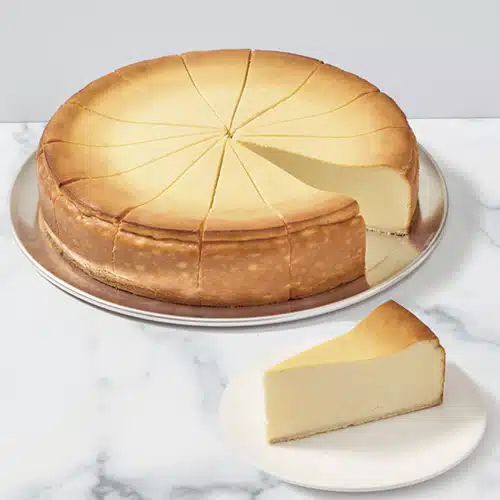
Originals and Classic Collection cakes on an all-butter shortbread cookie crust, cut in your kitchens. A lower price per slice than pre-cut, paid for with knife time and the risk of uneven portions.

Switch to Eli's pre-cut
How do the three scenarios compare, line by line?
Commodity wins on case price and distributor coverage, and Eli's pre-cut wins where labor and waste are the expensive lines. The comparison lines up commodity frozen cheesecake, Eli's whole cakes, and Eli's pre-cut formats on the eight lines a CFO signs off on, for a 40-unit group. Fill in your own prices and counts with the worksheet that follows the table on this page.
| What the CFO sees | 1. Stay with commodity | 2. Eli's whole cakes | 3. Eli's pre-cut |
|---|---|---|---|
| What you buy | Frozen cheesecake at the lowest case price | 9-inch Originals or 10-inch Classic Collection cakes, cut in house | Pre-cut cakes or Chi-Town Collection individually wrapped slices |
| Case price | Lowest of the three | Higher than commodity | Higher than commodity; compare per slice |
| Labor to portion | Same as today | Thaw, cut, and plate every cake at every unit | Pull, thaw, and plate; no cutting |
| Portion consistency | Same as today | Set by whoever holds the knife | Fixed before it ships |
| Waste | Same as today | A whole cake thaws at once; unsold slices become shrink | Thaw only the slices you need |
| Menu story | Generic cheesecake | Eli's Chicago-style cheesecake, a name guests know | The same name, the same slice every time |
| Distributor access | In most broadline catalogs | Check your distributor first | Check your distributor first |
| Best fit | Low dessert sales on a price-only menu | Units with a prep cook and steady dessert sales | Units with no pastry cook or uneven dessert sales |
On a phone, swipe the table sideways to see all three scenarios.
How do you build the cost model for 40 restaurants?
Build it per served slice, then multiply up to 40 units. Take four weeks of real data from three or four representative restaurants instead of the whole group, and scale from there. Each part of the formula comes from a source your team already keeps: invoices, the POS, the waste log, and payroll.
- Product cost per slice
- Case price ÷ slices you actually serve from the case at your portion size
- Labor per slice
- Minutes to thaw, cut, and plate one cake × loaded hourly wage ÷ 60 ÷ slices per cake
- Waste per slice
- Slices discarded ÷ slices sold × product cost per slice
- Cost per served slice
- Product + labor + waste. Then: cost per served slice × slices sold per unit per week × 40 units × 4.33 weeks = the group's monthly dessert cost.
- Pull dessert sales from the POS. Four weeks of cheesecake slices sold per unit, so you know weekly volume and how uneven it is.
- Count what goes in the trash. Ask each test unit to log every discarded slice for the same four weeks. Low-volume units usually show the most shrink on whole cakes.
- Time one cake. Clock thaw handling, cutting, cleaning the knife, and plating for a whole cake, and use the loaded wage of whoever does it.
- Get per-slice quotes. Ask every supplier, Eli's included, for price per slice at your portion size, not just per case.
Without the waste log, the model assumes every slice sells. That flatters whole cakes in both scenarios and hides the reason pre-cut can cost less per served slice.

Does a better cheesecake pay for itself through dessert attach rate?
It can, and you can find the break-even before you sign a group-wide contract. The extra slices each unit needs to sell is the added cost per slice times current weekly slices, divided by the gross profit on one slice:
(added cost per slice × weekly slices) ÷ gross profit per slice = extra slices per week to break even
A named dessert gives the server something to say beyond "we have cheesecake," which is when most tables ask for the check. Eli's is Chicago-style cheesecake from a third-generation family-owned bakery, baked on an all-butter shortbread cookie crust with cultured cream cheese and cultured sour cream and no fillers, stabilizers, or artificial ingredients. The Eli's Vegan plant-based line covers the table where one vegan guest would otherwise keep the whole party from ordering.
When should you stay with commodity cheesecake?
Stay with commodity when dessert is a price-only line, sells a few slices a week, and nobody on the floor mentions it. Sara Lee Frozen Bakery leads frozen cheesecake on cost per portion and sits in nearly every broadline catalog, and a premium name won't earn its cost on a menu that never sells it. If national brand recognition matters more to your guests than a Chicago story, The Cheesecake Factory Bakery is the stronger pick.
Check distribution before you build the model. Eli's isn't in every broadline distributor's catalog, and adding a vendor to your AP system for one dessert is a real cost your CFO will count. See where Eli's is sold or ask us which distributors carry Eli's in your region before you spend time on the math.
Questions people ask
Short answers to the cost questions operators, procurement teams, and finance leads ask before switching cheesecake suppliers.
How do I compare cost per portion when case weights and cut counts don't match?
Divide each case price by the number of slices you actually serve from it at your portion size, not by the count on the spec sheet. Then add labor per slice and waste per slice, so every supplier is measured per served slice.
What plate cost should I target for a premium cheesecake slice selling at $11?
At a 28 to 32 percent food cost target, an $11 slice can carry a plate cost of $3.08 to $3.52. At $9, the range is $2.52 to $2.88.
Is bulk uncut cheesecake cheaper than pre-portioned slices once labor and waste are counted?
Uncut cakes usually cost less per slice on the invoice, while pre-portioned slices take out cutting labor and the waste from thawing a whole cake at once. Which one wins depends on how many slices each unit sells per week and who does the cutting, so run both through the same cost-per-served-slice formula.
What if Eli's isn't in my broadline distributor's catalog?
Ask Eli's which distributors carry it in your region before you build the cost model. If yours doesn't, count the cost of a new vendor setup or a special order in the comparison, because your CFO will.
Does Eli's make a vegan cheesecake?
Yes. The Eli's Vegan plant-based cheesecake line gives a vegan guest a dessert, so one guest doesn't keep the whole table from ordering.
Bring Your CFO a Number, Not a Hunch
Tell Eli's your current dessert, your portion size, and your weekly slice count per unit, and ask for per-slice pricing and samples so you can run all three scenarios with real numbers.
Request samples